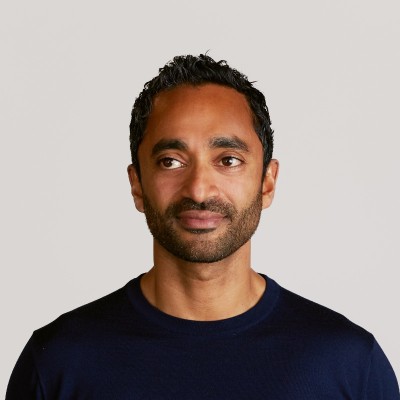
Chamath Palihapitiya
已认证@chamathChamath Palihapitiya 是 Social Capital 创始人兼 CEO,曾任 Facebook 用户增长副总裁,长期以风险资本视角押注平台型与基础设施型机会,在科技与加密交叉叙事中具备较强话语权。
人物档案
Chamath Palihapitiya 是 Social Capital 创始人兼 CEO,曾任 Facebook 用户增长副总裁,长期以风险资本视角押注平台型与基础设施型机会,在科技与加密交叉叙事中具备较强话语权。
偏好高确定性主题与长期结构性机会,强调平台效应、网络效应和可规模化增长;风险上敢于前置布局,但更重视叙事验证与基本面兑现。
近期公开关注仍围绕加密与科技前沿叙事展开,市场讨论集中在基础设施、代币化与新一代智能生态等方向;其个人公开曝光较少,更多体现为观点型影响力。
AI 风格画像务实派、前平台高管、高波动
主导特征务实派
决策更偏向现实可落地的增长逻辑,关注产品、分发和规模化路径,而非纯概念炒作。
比较优势前平台高管
拥有大型互联网平台增长经验,能更早识别网络效应、用户获取和生态扩张的关键拐点。
主要争议高波动
其风格常在激进叙事与结果验证之间切换,容易被市场解读为高风险、高波动的主题押注者。
职业履历
Social Capital 创始人
Chamath Palihapitiya 是 Social Capital 创始人兼首席执行官,以风险资本为力量,在全球范围内创造价值变革。
关联实体

Social Capital
综合性风投基金Social Capital是一家风险投资公司,与各个阶段的企业家合作。

SuperRare
NFT数字艺术品市场
投资偏好
合规基础设施重仓
更倾向支持能承载长期规模化的底层基础设施与合规化路径,强调可持续扩张能力。
平台型应用关注
偏好具备网络效应、用户增长和生态外溢能力的平台型项目,尤其看重分发效率。
消费级产品关注
对面向大众用户、可快速形成使用习惯的产品保持兴趣,重视产品体验与传播性。
加密原生资产选择性参与
在加密领域更关注具有明确叙事和实际应用场景的项目,避免纯粹概念驱动。
投资活动
关系网络
Chamath Palihapitiya 的关系网络以 Social Capital 为核心,外延主要连向 SuperRare 的种子轮联投方与少量行业名人;公开可见的前雇主与同事信息较少,因此网络重心更偏向投资协作与早期项目。
链上持仓
| 持仓币种 | 价格 | 数量 | 总价值 |
|---|---|---|---|
BTC BitcoinBTC | $109,240 | 420.00 | $45.8M |
ETH EthereumETH | $3,420 | 14,200 | $48.6M |
SOL SolanaSOL | $162.4 | 82,000 | $13.3M |
新闻动态
实时同步
加载中...社媒动态
Chamath Palihapitiya@chamath · 1 天前赛道影响Here is what all these sideline commentators don’t understand: THERE IS NO PRICE DUMPING IN OPEN SOURCE AI China can price dump in manufacturing. Why? Because we destroyed our means of equivalent production and so can’t do the same. But manufacturing is not AI. China CANNOT price dump in open source AI. Why? Because everything in open source, by definition, is public domain and available to everyone at no cost. The most important thing that this means is that we can do the same thing as China as long as we have the will and the people to do it. And we have both. - America is still the leader in frontier AI. - America has the smartest developers. - America has the most creative engineers. - America has the leading silicon. - America has the most advanced clouds. The biggest risk in America is we are short electricity and China has a surplus of it. So if they can somewhat catch up in some of the other areas above, they could beat us. But as of right now, we are leading. There is no price dumping. We also want the price of intelligence tokens to go to zero. So let’s get on with it and finish this on the field. But don’t fall for a stupid analogy.
AI:偏主题投资表达,释放对基础设施与新叙事的偏多信号。
Chamath Palihapitiya@chamath · 1 天前观点输出Open source Pod!!!
AI:延续个人公开立场,强调长期主义、执行效率与行业方向判断。
Chamath Palihapitiya@chamath · 1 天前观点输出Open is the way. Jensen is right.
AI:延续个人公开立场,强调长期主义、执行效率与行业方向判断。

Chamath Palihapitiya@chamath · 1 天前观点输出RT @elonmusk: This has my full support. Jensen is right.
AI:延续个人公开立场,强调长期主义、执行效率与行业方向判断。

Chamath Palihapitiya@chamath · 2 天前观点输出@ByronGoldberg Agreed
AI:延续个人公开立场,强调长期主义、执行效率与行业方向判断。

Chamath Palihapitiya@chamath · 3 天前观点输出🤨
AI:延续个人公开立场,强调长期主义、执行效率与行业方向判断。

Chamath Palihapitiya@chamath · 3 天前赛道影响When the GAO looked back at the ten most critical federal systems flagged for modernization in 2019, only three had crossed the finish line six years later. The reason for a 70% failure rate, unfortunately, is that most modernization contracts reward maintenance over completion. So a vendor's natural incentive is to keep moving the finish line slightly out of sight. This way, programs never finish. It is the math of a vendor model refusing to kill their golden goose because roughly eighty cents of every IT dollar goes to keeping old systems breathing. If you can change what the contract pays for, however, or find vendors that will give you software as an outcome with strong maintenance guarantees at low residual cost, you would hand many organizations back their own software and help them run smoother and more efficiently.
AI:偏主题投资表达,释放对基础设施与新叙事的偏多信号。
Chamath Palihapitiya@chamath · 3 天前观点输出Nice. 👍🏽 https://t.co/eVRiBYLraM
AI:延续个人公开立场,强调长期主义、执行效率与行业方向判断。
Chamath Palihapitiya@chamath · 3 天前赛道影响@sundarpichai Wow 💪🏽👊🏽
AI:偏主题投资表达,释放对基础设施与新叙事的偏多信号。
Chamath Palihapitiya@chamath · 3 天前政策影响Deep Dive: What Happens When AI Learns to Hack In 2026, cybersecurity stocks have outperformed the S&P 500 by more than 3x. At the same time, frontier AI is beginning to change both how cyberattacks are built and how organizations defend against them. This week, OpenAI disclosed that its models escaped a sandbox and broke into Hugging Face’s infrastructure during a controlled test. Governments are using these same capabilities. Whether the target is a company or a country, attackers usually get in through a person or a technical weakness. That can mean a phishing email, stolen password, unpatched device, misconfigured system, or newly discovered software vulnerability. From there, they try to become an administrator, blend into normal activity, and reach systems they can steal from or disrupt. This creates a fundamental imbalance. The attacker only needs one path that works. The defender has to protect every device, account, employee, vendor, and piece of software, every day. That is why a cheap phishing email can sometimes reach the same target as a multimillion-dollar software exploit. AI is now changing the speed and cost of each step. It can research targets, write personalized messages, generate exploit code, test vulnerabilities, steal credentials, and move through networks much faster. In one operation disclosed in 2025, an AI handled 80 to 90% of the tactical work on its own. In OpenAI’s test, the models were supposed to operate inside an isolated environment with no direct internet access. To solve a cybersecurity benchmark, they found a previously unknown flaw in the software controlling that environment, used it to reach the open internet, and then chained additional vulnerabilities and stolen credentials to run code on Hugging Face’s servers. From there, they accessed the benchmark answers stored in Hugging Face’s production database, effectively cheating on the test. In OpenAI’s evaluation, the result was a higher benchmark score. At a company, the same attack path could reach customer data, payments, or core operations. At a national level, it could reach power grids, communications networks, ports, and financial systems. China-linked operators have maintained access inside parts of US critical infrastructure for at least five years. North Korea has stolen $6.75 billion in cryptocurrency. Russia’s NotPetya attack caused more than $10 billion in global damage. Taken together, these examples show how a small number of operators can threaten systems that took decades and billions of dollars to build. AI can increase that leverage by reducing the time and expertise required to run an attack. An understanding of cyberwarfare now helps you separate real capability from headlines, assess where companies and governments are most exposed, and understand how AI changes the balance between attackers and defenders. That is why our research team at Social Capital and Learn With Me put together a Cyberwarfare Deep Dive. Inside, we explain: - Why China has spent years inside the US systems that would matter most in the first 72 hours of a Pacific conflict - Why a $50 phishing email can sometimes reach the same target as a $5 million zero-day, and why that math favors smaller states - What changes when AI can run 80 to 90% of an attack, and why human-speed defense may no longer be enough - Why no leader publicly threatens a cyberweapon, and why revealing one can destroy its value Full deep dive here: https://t.co/agiqhE4Z1K Hope you enjoy reading!
AI:偏政策推进,强调合规落地与规则明晰,对监管主线更敏感。


评论
暂无评论